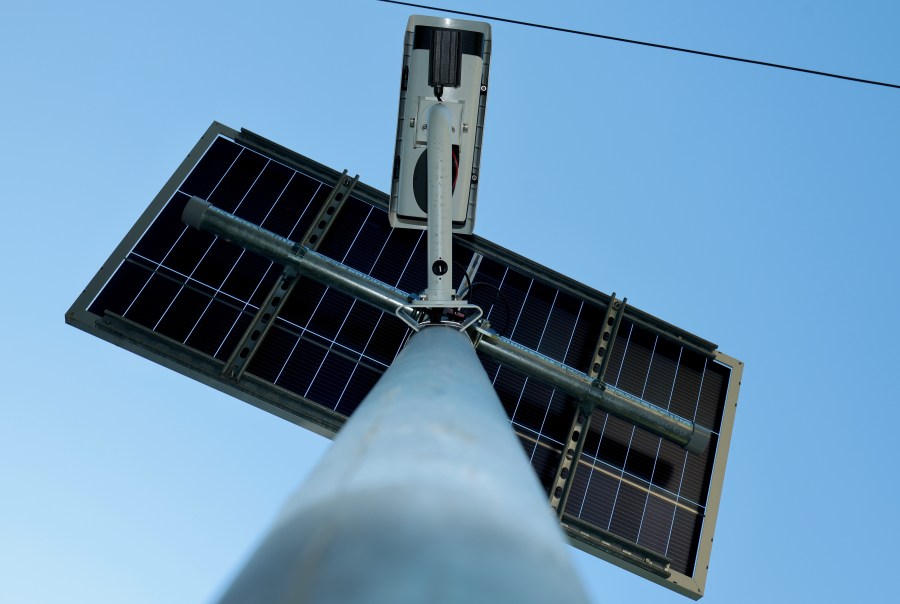
A Flock automatic license-plate reader camera. Image published with KNWA/FOX24's coverage of Van Buren's updated camera restrictions.
Hey Van Buren — we’ve got a meaningful follow-up on those Flock license-plate cameras.
Earlier we learned Van Buren Police was reducing how long routine Flock camera data stays in the system from 30 days to seven.
Now Chief Jonathan Wear has laid out the rest of the restrictions, and they go quite a bit further than simply deleting records sooner.
Van Buren Police is also tightening who can access the system and what officers are allowed to use it for.
Under the updated policy, direct access to Van Buren's Flock system is restricted to Van Buren Police Department employees.
Outside law-enforcement searches will be limited to agencies located within the State of Arkansas.
That’s an important detail because Flock systems are designed around networks of automatic license-plate readers that can potentially make vehicle information searchable across multiple jurisdictions.
Van Buren is putting a geographical limit around that access.
The department is also spelling out what qualifies as an acceptable reason to search the system.
Searches will be restricted to felony investigations, missing-person cases, warrants, narcotics investigations, certain misdemeanor theft cases and certain domestic-battery cases reported within 12 hours of the incident.
If officers need access for something outside those categories, the policy requires documented special approval.
That changes the conversation quite a bit.
A seven-day retention period is one privacy safeguard.
But who can actually search the database — and why — is arguably just as important.
Flock cameras work by automatically photographing passing vehicles and recording information such as the license plate, vehicle characteristics, location, date and time.
Authorized police users can search those records during investigations.
There are obvious situations where that can be valuable.
If somebody steals a truck in Van Buren and drives toward another city, a plate reader could potentially show investigators where that vehicle traveled.
The same technology can help officers looking for a missing person, someone with an active warrant or a vehicle connected to a serious crime.
That’s why departments around the country have invested heavily in these systems.
But the privacy question comes from everything happening in between those investigations.
Thousands of people drive around Van Buren every day without being suspected of a crime.
They go to work.
They take their kids somewhere.
They cross the bridge into Fort Smith.
They grab groceries or go eat.
The question residents have been asking is how much information about those ordinary trips should sit in a searchable law-enforcement database and who should be able to look through it.
Van Buren now has clearer answers.
Routine data will be retained for seven days.
Direct system access stays with Van Buren Police employees.
Outside law-enforcement searching is limited to Arkansas agencies.
And searches have to fit specific investigative categories unless special access receives documented approval.
Chief Wear said the department has spent the past several weeks reviewing and strengthening its policies around automatic license-plate readers.
He also said the department will continue talking with legislators, city leaders and members of the community about balancing the public-safety value of the technology with residents' privacy expectations.
That’s probably the right place for the conversation to be.
The technology itself isn't automatically the problem.
What matters is how it gets used.
A tool that helps locate a stolen vehicle or missing person is easy to understand.
A system where people can casually search where somebody's vehicle has been with no meaningful oversight would be a completely different thing.
That’s why access limits, approved search purposes, audit trails and retention rules matter.
There’s also a River Valley angle here now.
Fort Smith and Van Buren have both tightened their Flock policies within days of each other.
Neither city is removing the technology.
Instead, both are trying to keep the crime-fighting benefit while putting more guardrails around everyday vehicle-location data.
The next thing worth watching is how those safeguards are actually enforced.
That could include whether the city releases periodic search statistics, audit information, reports of policy violations or additional rules covering misuse.
Community takeaway: Van Buren Police has now released the full set of new restrictions surrounding its Flock automatic license-plate readers. Routine data retention is dropping from 30 days to seven. Direct system access is restricted to Van Buren Police employees, outside searches are limited to Arkansas law-enforcement agencies, and searches are restricted to specific investigative purposes including felonies, missing persons, warrants, narcotics cases and certain theft and domestic-battery investigations. Special access outside those categories requires documented approval. The cameras remain in use, but the rules around who can search them and why are now significantly tighter.
Fort Smith Community Hub
Keeping our community connected, one story at a time.
📍 Fort Smith, Arkansas · 479 · iam479.com.
Sources: KNWA/FOX24 — Van Buren police chief announces new limitations for Flock Safety cameras · 5NEWS — Van Buren becomes latest Arkansas city to limit Flock camera use


Comments
Post a Comment